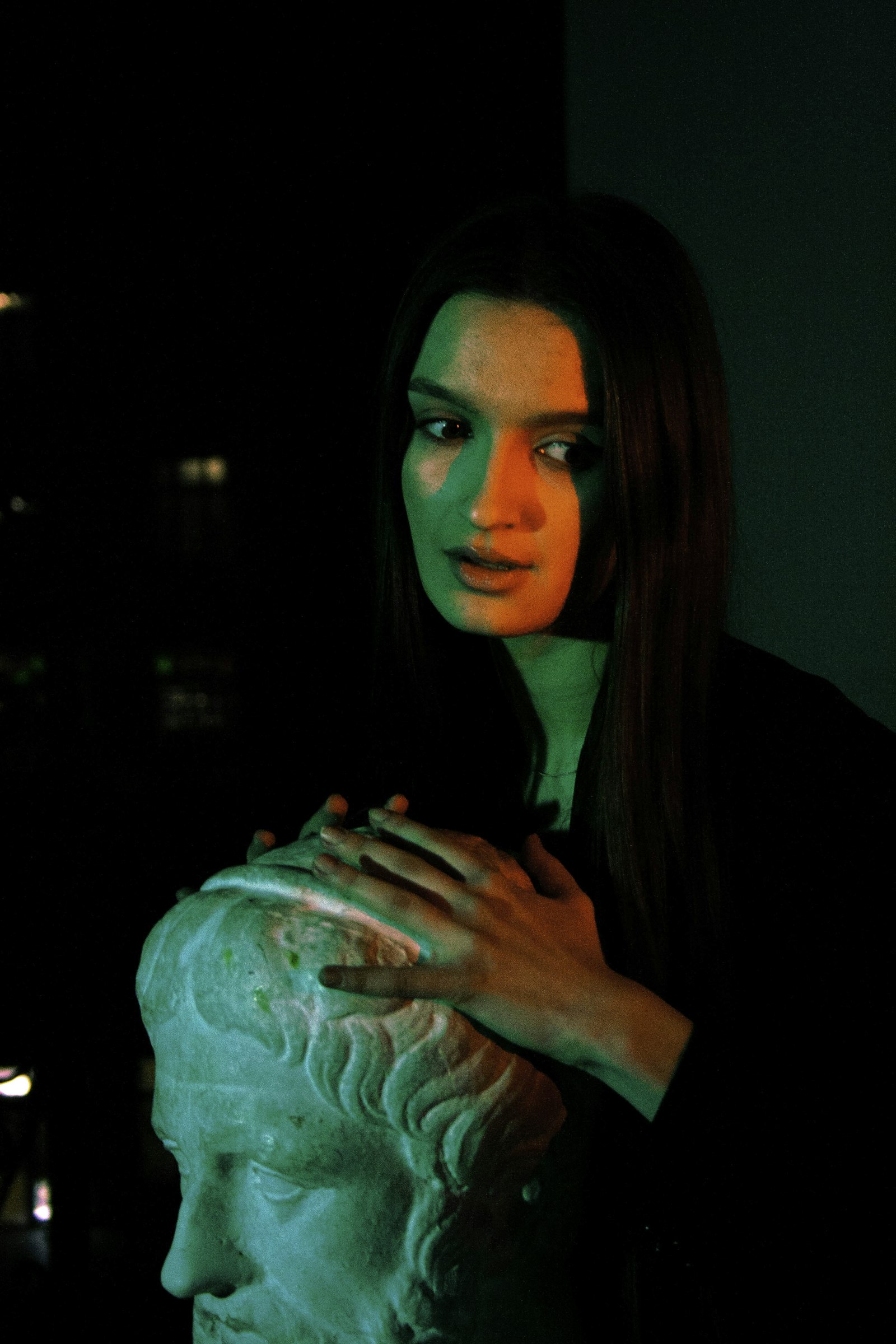
His name, according to the crate, was INV. NO. 114-B. The photographer called him Maksym. He was a marble bust of some minor Roman (a magistrate, we decided, someone who audited grain shipments and was beloved by absolutely no one) borrowed from a private collector for one night and insured for more than my flat. My job was to hold him, in green light, and match his stillness. Marble has a four-thousand-year head start at this. I'd had coffee.
Here is what you learn holding a Roman for three hours: stone is a genius of posture because it has no choice, and the camera loves things that have no choice. My whole craft is manufacturing that inevitability: making a lifted chin look like the only place my chin could ever have been. Maksym didn't manufacture anything. He simply was, at 23 kilograms, in my arms, while the green gel turned us both the colour of an old aquarium.
The photographer wanted the two faces to read as equals: same angle, same blankness, same refusal to perform. It's harder than it sounds to be as uninterested as a rock. Every instinct I have points toward the lens; his, if he ever had any, point toward the eternal. Somewhere around the second hour I stopped trying to match him and started listening instead: to the hum of the light, my own pulse in my forearms, the collector in the corner making small noises whenever I adjusted my grip.
The frame that survived is the one where I'd genuinely forgotten to care. That's always the frame. You work and work at stillness and then real stillness ambushes you somewhere past exhaustion, and the shutter happens to be open. Maksym knew this all along, I think. Four thousand years of shutters happening to be open.
When they crated him up, I said goodbye out loud, which I regret only because the collector heard me. The picture ran in spring. He got the left half of the spread, I got the right, and in the credits, I notice, the stone is listed first. I've decided to find this funny. Seniority is seniority.