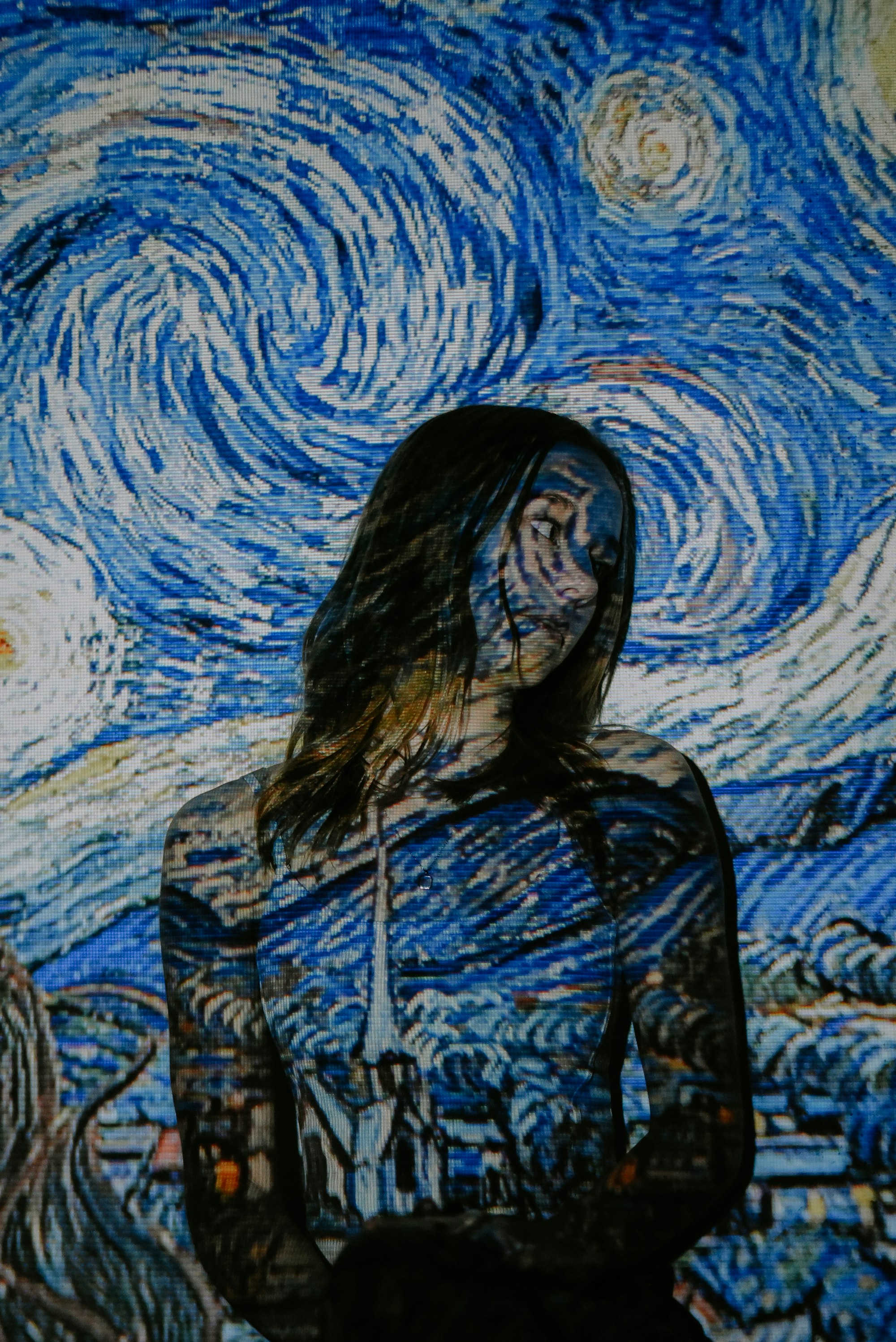
There is a moment, about four minutes into standing inside a projected Starry Night, when your brain gives up trying to sort out what is you and what is painting. The brushstrokes crawl, they really do crawl, the animators have set the whole sky slowly turning, and because everything around you is moving, your body decides that you must be moving too. You aren't. You're standing on a piece of gaffer tape in a dark room in an industrial park outside Amsterdam. But try telling your inner ear that.
The brief was simple and impossible: be in the painting without interrupting it. The projection doesn't pause for you. If you shift your weight, a church spire bends across your collarbone and the whole illusion snaps. So you learn to move between the swirls, the animation loops every ninety seconds, and there's a gap, maybe four seconds long, where the sky goes quiet over the village. That gap is when you breathe, blink hard, and re-set your shoulders. The rest of the time, you belong to Vincent.
What nobody warns you about is the scale. In a normal shoot you are the subject; the light arranges itself around you. Inside an installation you are a detail. The photographer kept saying "smaller" (not the pose, me, my presence) and somewhere around the twentieth frame I understood. The picture isn't of a woman in front of a painting. It's of a sky so large it happens to contain a woman. Once I stopped competing with it, the frames started working.
We finished after midnight. Walking to the tram I looked up at the actual sky (flat Dutch cloud, one visible star, orange city haze) and felt weirdly protective of it, like I'd spent the evening with its more glamorous sister and owed it an apology. It has no animators, the real sky. It does all of that by itself, every night, for free.
I left a cornflower on the projector cart. The technician texted me a photo of it three days later, still there, going quietly blue in the machine light. Right where I'd stood.