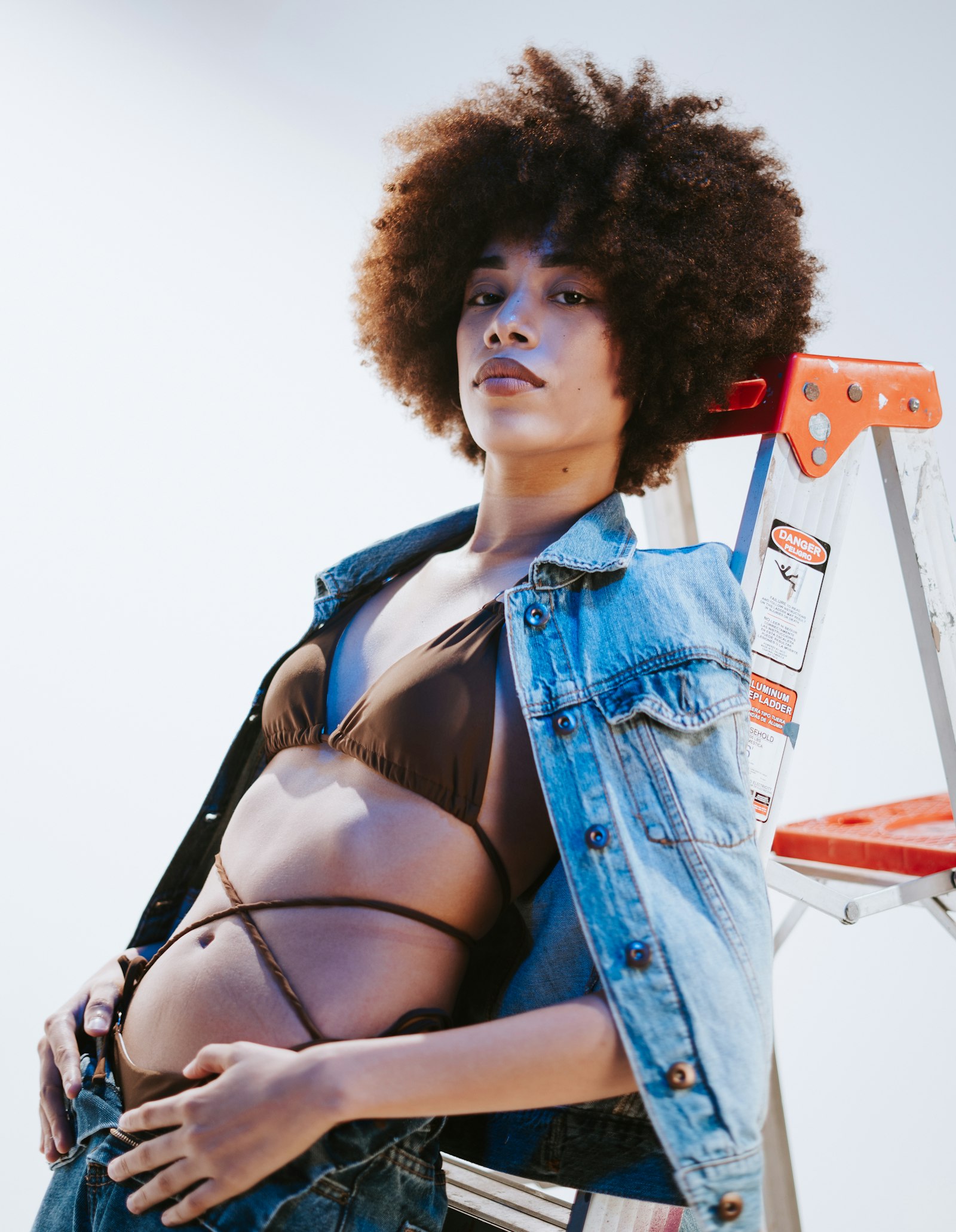
The call sheet said: white cyclorama, denim story, minimal props. What was waiting for us in the studio was a step-ladder the colour of a traffic cone. Nobody knew whose it was. The studio manager denied it three times, like Peter. The photographer circled it for a while with the expression of a man doing maths, and then said the sentence that defined the next nine hours: leave it, it's the only thing here with an opinion.
I have worked with props before. Chairs that wanted to be thrones, motorcycles with more handlers than I had, a marble column made of foam that had to be guarded from wind. But the ladder was different, because the ladder did not care. It stood there in its municipal orange being entirely itself, and next to all that white it looked like a scream in a library. My job became a negotiation: how close can you stand to a scream and still be the subject?
The answer, we found, is about one metre, angled away, with the jacket half off the shoulder. Any closer and I became the ladder's assistant. Any farther and the frame turned back into a catalogue. There was one exact distance where we balanced, me and the ladder, subject and disturbance, and when we hit it the whole crew went quiet in that way that means the picture happened.
What I took from that day, apart from a lasting respect for hardware-store colour theory, is that perfect emptiness photographs as nothing at all. The white cube needs its one wrong thing. A ladder, a shadow, a freckle. The disturbance is what proves the order around it was a choice and not an accident. I have started looking for the orange ladder in every brief since. Sometimes it's an actual object. More often it's a decision no one will admit to having made.
The ladder, I'm told, is still in that studio. Bookings now occasionally request it by name. It has, without a comp card or a portfolio or a single day of dance training, become a working model. I refuse to be bitter. We came up together.